Thursday, February 15, 2018

24. Monocacy National Battlefield, Maryland


               Hello and welcome back to our blog.  In this post, we return to western Maryland to another Civil War locale, Monocacy National Battlefield.

Entrance Sign

BACKGROUND:
               In the summer of 1864, with General Ulysses S. Grant continuing to push to take the Confederate capital of Richmond, the Confederates hoped to turn the tables on the Union by risking a bold lightning attack on the now lightly defended District of Columbia.  A Confederate army under the command of Jubal Early, swept out of the Shenandoah Valley to attack the national capital from the northwest.  Most of the garrison of Washington D.C. had been stripped from the city’s fortifications and sent to the front, leaving the capital dangerously unguarded.  As Early’s army came over the mountains of western Maryland, panic gripped the Union command as they desperately moved to counter the threat.  A small force cobbled together from available units was put under the command of Union General Lew Wallace, who would gain post-war fame as the author of the epic novel Ben-Hur, assembled ready to stall the Confederates along the banks of the Monocacy river south of the town of Frederick, Maryland.
Personal items belonging to General Lew Wallace, on display in the visitor center.

               On the morning of July 9th, 1864, the Confederates marched south from Frederick to seize two bridges, one a vital railroad bridge, across the Monocacy river on the road to Washington.  Union troops skirmished north of the river before falling back across the river and burning the two bridges to prevent their use by the Confederates.  However, Confederate cavalry were able to find a shallow crossing to the west of the bridges and forded the river.  Fortunately for the Union, they detected the Confederates and ambushed them, forcing them back.  More Confederates arrived pushing the Union troops further back and threatening to flank them.  At this point, Wallace ordered his men to retreat.  While the Union had been defeated, Wallace’s scratch force had accomplished their mission of buying time for Union reinforcements to secure Washington.
The modern road bridge over the Monocacy river at the same location as the original covered bridge that was burned by Union troops during the battle.

               The Monocacy battlefield lay mostly forgotten until a bill for its creation as a National Park Service unit passed Congress in 1934.  Even then, the battlefield sat there mostly empty until the 1970s when a more active campaign to preserve the area was waged following the decision to construct Interstate 270 right across the middle of the battlefield.

THE BATTLEFIELD:
A view of the northern half of the battlefield from the visitor center.

               Monocacy National Battlefield lies at the southern edge of the town of Frederick, Maryland, on both the north and south banks of the Monocacy river.  The area along the north bank has been encroached upon the city development, but the area around the southern bank retains the rural look the area had in 1864.  The battlefield preserves several historic houses that existed on the land at the time of the battle, as well as a handful of monuments erected following the war.  The railroad line and the road to Washington D.C. still cross the battlefield in the exact same locations as in 1864.  The park also contains several trails across the battlefield, and the visitor center is located on the northern edge of the battlefield just off of Maryland Route 355.  The visitor center contains exhibits and artifacts from the battle as well as a topographical light-board which demonstrates the positions of the armies during the course of the battle.
 
A photo of the topographical light board in the visitor center.  The red lights represent Confederate units, blue Union.

TRAVEL TIPS:

               Monocacy National Battlefield is open year-round with holiday exceptions from 9am to 5pm.  The battlefield is within a short drive from the nearby NPS units of Antietam NB and Harpers Ferry NHP, and is roughly a little over an hour’s drive outside of Washington D.C.  The visitor center and some of the trails are handicapped accessible.  Passport stamps can be found in the visitor center.

ADDITIONAL PHOTOS:


The monument at the battlefield to Union troops from Pennsylvania.

The Thomas Farm at the center of the battlefield's southern half where most of the fighting took place.

A view from the Thomas farm looking west in the direction from which the Confederates attacked.

The Worthington House, near the western edge of the battlefield.  Confederate Cavalry forded to the river to the rear of the house and were ambushed by Union troops in the vicinity of the house.

Thursday, February 1, 2018

23. Perry’s Victory and International Peace Memorial, Ohio


               Hello, welcome back to our blog on the National Park Service.  For our latest post, we come home to our native Ohio to visit the location of Ohio’s greatest battle, and the monument that commemorates it and our greatest peace with a foreign nation, Perry’s Victory and International Peace Memorial.


Entrance sign

BACKGROUND:
               In September of 1813, Britain and the United States were contesting control of the Great Lakes as part of the War of 1812.  Whoever controlled Lake Erie in particular, would have near unfettered dominance of the upper Great Lakes and potentially lead to the conquest of either Michigan or Ontario.  Both sides rushed to build ships suitable for the lake and on September 10th, 1813, they met in battle off South Bass Island in Lake Erie.

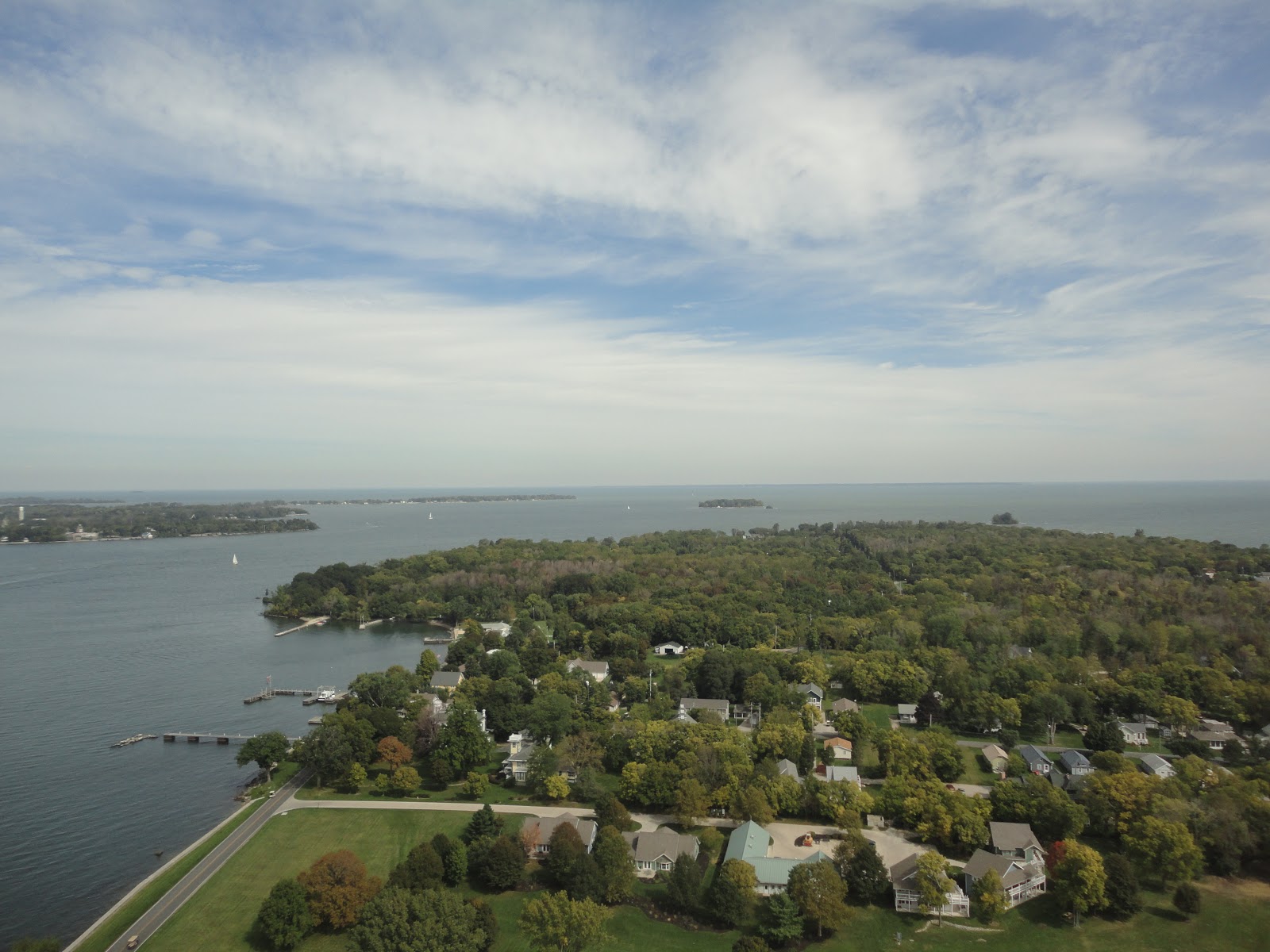
A view of the area on which the Battle of Lake Erie was fought, as seen from atop the Perry's Victory monument column.  The two squadrons engaged each other to the northwest, just beyond Rattlesnake Island, the small island in the center of the photo.  The anchorage of Put-In-Bay is seen at lower left.

               At first the British seemed to have the upper hand.  The American flagship, U.S.S. Lawrence, had become separated from the rest of the squadron and faced the entire Royal Navy force virtually alone.  Although her crew were able to dish out as much punishment as they received, the Lawrence was soon reduced to a wreck.  At this critical moment, rather than admit defeat, the American commander, Commodore Oliver Hazard Perry decided to continue the fight.  Hauling down his battle flag, emblazoned with the last words of his best friend fellow naval officer James Lawrence, “Don’t give up the ship!” Perry boarded a small boat and rowed under enemy fire to reach the rest of the U.S. squadron.  After assuming command of the U.S.S. Niagara, Perry led the squadron back into battle decisively defeating the British, capturing the entire Royal Navy squadron.


Perry's famed "Don't Give Up the Ship" battle flag, which flew above both the U.S.S. Lawrence and U.S.S. Niagara during the battle, currently on display at the U.S. Naval Academy in Annapolis, Maryland.

               A century later, to celebrate the centennial of the battle, a massive stone column was erected as a monument, not only to the American victory at the Battle of Lake Erie, but to the lasting peace forged at the war’s end which lead to the United States and Canada enjoying the longest undefended border in the world.

A view of the monument column from the memorial grounds with the flags of Canada, Great Britain, and the United States in the foreground.  Note that the U.S. flag on display is the War of 1812 fifteen stars and fifteen stripes version.

THE MEMORIAL:
               Perry’s Victory and International Peace Memorial is located on South Bass Island, more commonly known as Put-In Bay after the town centered on the island’s harbor, among the Lake Erie Islands in Ohio.  The Memorial comprises a thin strip of land across the neck of South Bass Island, upon which sits the largest Doric column in the world.  The column stands atop the site where six officers who were killed during the battle, three American and three British, were laid to rest.  Within the base of column is a small rotunda where plaques list the U.S. casualties from the Battle of Lake Erie.  Directly above the rotunda is an elevator which transports visitors to an observation platform at the very top of the monument.  The visitor center is located at the south end of the park lawn surrounding the monument.

A statue depicting Commodore Perry on display in the visitor center.  The monument column is directly behind the statue through the windows.

TRAVEL TIPS:
               In order to visit Perry’s Victory and International Peace Memorial, visitors will need to arrive on South Bass Island by either boat or aircraft.  It is recommended to take one of the several ferries from the mainland instead of a boat or plane rental.  While cars are allowed on the ferries it is generally recommended to park on the mainland and rent a golf cart (the primary mode of transportation on the island) or a bicycle.  The memorial grounds and visitor center are located on the northern edge of the town of Put-In-Bay, a popular tourist destination in the summer months filled with both restaurants and souvenir shops (replica "Don't Give Up the Ship" flags are ubiquitous).  It is highly recommended to check the memorial's schedule ahead of your visit in case special programs are planned.  If you time your visit right you may get the chance to see the actual U.S.S. Niagara which still sails the lake (albeit heavily rebuilt after two hundred years) on a call to Put-In-Bay.  The ship is based in Erie, Pennsylvania.
               The memorial and its visitor center are only open from late May through to late October, closing in the winter months.  The visitor center is open daily from 10:00am to 6:00pm in the summer, and open on the weekends in October.  A small fee is required to take the elevator to the monument’s observation deck.  Passport stamps can be found in the visitor center.

ADDITIONAL PHOTOS:


Another view of the memorial's monument column.

Artifacts from the Centennial commemorations of the Battle of Lake Erie and the dedication of the memorial on display in the visitor center.

A volunteer in period sailing garb demonstrating the use of a flintlock musket on the memorial grounds.

A marker in the rotunda of the monument column signifying the graves of six officers killed during the battle.

One of the plaques displaying the names of the men in the U.S. squadron killed and wounded during the Battle of Lake Erie in the monument column's rotunda.  The majority of the American casualties came from U.S.S. Lawrence.  (Note the writing is done in a Latin style popular on monuments in the early 1900s.  As such the letter 'U' is rendered as a 'V'.)

One of several bronze plaques in the room with the column's elevator that display the names of the remaining American sailors that participated in the battle.

A view from the column's observation platform looking north.  Middle Bass Island is at left.  The dark line along the horizon is the Canadian Pelee Island.  On a clear day the north shore of Lake Erie is just visible.

Wednesday, January 17, 2018

Affiliated Area: Touro Synagogue National Historic Site, Rhode Island


               Hello and welcome back to our blog on the National Park Service.  In this latest post, we look at our second “Affiliated Area” to the NPS, the Touro Synagogue National Historic Site in Newport, Rhode Island.

 
The Touro Synagogue National Historic Site.

BACKGROUND:

               Today Newport, Rhode Island, is best known for its famed Gilded Age mansions.  However, in its early history it was one of the country’s foremost thriving seaports.  As a result of its international shipping industry, and Rhode Island’s colonial charter giving all its citizens the protection to their right of freedom of religion, the town attracted a wide array of ethnic and religious groups and became the location of one of the United States’ oldest Jewish congregations.

               The synagogue was constructed in 1763 for Newport’s small but well established Jewish population.  Following depredations inflicted on Newport during the American War of Independence, the congregation dwindled and struggled to survive.  For long stretches the synagogue was closed during the 1800s, often rumored to be a stop along the Underground Railroad.  The synagogue was restored in the 1880s and remains an active congregation to this day.  The Touro Synagogue was designated a National Historic Site in 1946, but as it remains a privately-owned house of worship it is only an Affiliated Area of the National Park Service and not an official unit.

 
The interior of the synagogue.

THE SITE:

               The Touro Synagogue National Historic Site consists of the synagogue, a small park on its grounds, and the Ambassador John Loeb Jr. visitor center.  The synagogue is architecturally significant, contains a prized four-hundred-year-old copy of the Torah, and is the oldest synagogue in the United States.  The Loeb visitor center contains a short film on the history of the synagogue and exhibits on the Newport congregation and prominent Jewish Americans.

 
The park lawn in front of the synagogue and the rear of the Loeb visitor center.

TRAVEL TIPS:

               Touro Synagogue National Historic Site is located in the historic center of Newport Rhode Island at the intersection of Touro and Spring streets.  The historic section of Newport contains very narrow streets and parking is limited.  It is recommended that once visitors find a suitable parking lot that you then walk to the synagogue.  Fortunately, the center of Newport is compact and easily walkable.  The Touro Synagogue NHS is open year-round, with varying hours depending on the season, with tours taking place every half hour typically between 12:00pm and 1:30pm, except on the Sabbath and Jewish holidays.  The visitor center is open longer, usually from 11:30am to 2:30pm, with extended hours during the summer.  The site is handicapped accessible.  A NPS passport stamp can be found at the front desk.

Friday, January 5, 2018

22. Hawaii Volcanoes National Park, Hawaii

               Hello and welcome back to our blog.  In this post we make our second visit to one of the big 59 National Parks, and our first visit to the nation’s 50th State as we travel to Hawaii Volcanoes National Park!

Entrance Sign

BACKGROUND:
               The Hawaiian Islands are the product of millions of years of geological activity.  Located in the middle of the Pacific Ocean, the islands were created through volcanic eruptions as the Pacific tectonic plate gradually moved over what is known as a ‘hot spot’, a weak area in the Earth’s crust.  At these hot spots, volcanic eruptions are frequent, and in the case of Hawaii, created the entire island chain as the hot spot built up volcano after volcano.  The hot spot in the Pacific plate currently resides under the largest of the Hawaiian Islands, the namesake of the island chain, better known simply as the Big Island.
               The geologic properties of the Pacific hot spot have led Hawaii to be the home of the world’s most active volcanoes, in particular Kilauea, which has been erupting continuously since 1983, and at the time of this writing, is erupting in two places at the same time.  The constant eruptions on the island led the Ancient Native Hawaiians to believe it was home to the Polynesian fire goddess Pele, and the volcanoes held a deep religious significance.  The lava spewed forth from the volcanoes continues to add rock and landmass to the island of Hawaii every year.

Kilauea volcano crater.

               To recognize the uniqueness of the volcanic landscape, the area surrounding Kilauea, the larger Mauna Loa volcano, and Haleakala on the island of Maui were designated Hawaii National Park in 1916.  Later in 1961, Haleakala was split off to create its own National Park, with the park lands on the Big Island re-designated Hawaii Volcanoes National Park.

THE PARK:
               Hawaii Volcanoes National Park surrounds the peak of Kilauea volcano and a large area down its southwest flank extending to the island’s coastline.  The park also stretches up over the top of Mount Mauna Loa, the second tallest mountain on the island and largest mountain landmass in the world.  A section of tropical rain forest near the volcanoes is also preserved as a wilderness.

Mount Mauna Loa, which overlooks Kilauea.  Note the thin line of snow atop the summit.

               The Park is centered on the summit of Kilauea volcano.  At the summit is the volcano’s primary crater, several miles wide, at the center of which is a further two craters, the smallest of these two contains a lake of lava in constant eruption since 2008.  There are two visitor centers on the crater rim, the primary visitor center near the park entrance, and the Thomas Jagger Museum which overlooks the crater and is home to an observatory of the U.S. Geological Survey.  A road once circled the entirety of Kilauea crater, but the southern half of the road and a zone downwind of the summit has been closed for the duration of the current eruption due to safety concerns.  Also around the summit crater is the Volcano House, a hotel lodge with views of Kilauea, and the Kilauea Military Camp, a recreation area reserved for Military personnel.

The U.S. Geological Survey observatory which monitors Kilauea from the Jagger Museum.

               To the east is Kilauea’s smaller neighbor, Kilauea Iki crater, and the Thurston Lava Tube, a cave cut through the rock by a lava flow.  From there, meandering southeast, is Chain of Craters Road, which passes by a series of craters left by various eruptions in Kilauea’s East Rift Zone.  The road continues across a vast lava field and down a massive escarpment toward the ocean, terminating on the coast at the famed rock formation called the Holei Sea Arch.  The road once connected with a seaside highway, but the road was cut by lava flows in 1987 and remained closed ever since.  The source of these lava flows is Pu’u’O’o, a volcanic cone which has been erupting continuously since 1983, the world’s longest recorded eruption.

The Holei Sea Arch.

TRAVEL TIPS:
               Hawaii Volcanoes National Park is a roughly half-hour drive south from the city of Hilo, the island of Hawaii’s largest population center, and an hour and a half from Kailua-Kona on the island’s west coast.  The park is open twenty-four hours a day year-round including holidays.  The main visitor center is open from 9am to 5pm, and the Jagger Museum from 10am to 8pm.
               How visitors explore Hawaii Volcanoes National Park will be a matter of personal preference.  It is recommended that visitors budget an entire day to see both visitor centers and the length of Chain of Craters Road.  Nighttime viewing of Kilauea crater from the Jagger Museum is a popular attraction, though parking at the museum may be restricted necessitating a hike from other nearby parking lots.  There are similar parking restrictions at the Thurston Lava Tube.  There are restaurants within the Volcano House open to the public for lunch and dinner.

Kilauea volcano at night seen from the Jagger Museum.

While it is prohibited to visit the Pu’u’O’o Lava cone on foot, it can be seen via helicopter rides, and the lava flows from this peak can be seen up close, however a great deal of hiking will likely be necessary to find an active flow (as one Park Ranger told us, “If the lava doesn’t kill you the hike will”).  The park has two established campgrounds.  The southern area of the park contains several sites for backcountry camping.  Mount Mauna Loa, at over 13,000 feet in height, can also be climbed but only by prepared and experienced climbers.  Climate conditions at Kilauea Crater may at times also be moderately chilly.  Visitors are advised to take heed of all warning signs due to the inherent danger of the terrain. 
There are gift shops located in both visitor centers.  The primary visitor center has a short film while the Jagger museum displays feeds of recent seismic data from the volcano.  Some areas of the Park are handicapped accessible, however most trails are not.  Passport stamps can be found at the primary visitor center and the Jagger Museum.


ADDITIONAL PHOTOS:

Kilauea Iki crater which last erupted in 1959.  The gray line across the crater floor is a hiking trail.
The original Volcano House, near the visitor center, which is now an art gallery.

A steam vent near the crater rim.

The edge of Kilauea crater known as Steaming Bluff from the numerous steam vents along the crater rim.

Kilauea crater in the daytime.


The area known as Sulphur Banks (note British style spelling), created by sulfur vents from deep within the volcano.

A dangerous example of what happens when visitors do not heed warning signs.  This vent at Sulphur Banks was created when a visitor stepped off the boardwalk and broke through the unstable ground, resulting in serious burns.

Volcano House lodge.

Visitors pass through the Thurston Lava Tube.
The area just off Chain of Craters Road with the Mauna Ulu volcanic cone in the background.  In the foreground is a fissure where lava erupted in 1969.

A close up photo of rock from the 1969 fissure eruption showing smooth multicolored volcanic glass.

Chain of Craters Road as it passes over hardened lava flow rock.

A view from Chain of Craters Road looking down the escarpment towards the ocean.  The black discoloration on the plain below is the lava rock flows from the Pu'u'O'o lava vent which has been continuously erupting since 1983.

The road block which cuts off Crater Rim Drive which once circled Kilauea crater.  Mauna Loa is in the background.

A sample of cooled lava rock known as Pele's hair for its stringy hair-like appearance, formed as lava cooled in small strands in mid-air during an eruption.


An example of the lush tropical rain forests that surround Kilauea above ground at the Thurston Lava Tube

Snow capped Mauna Kea, the tallest mountain on Hawaii, seen from the Jagger Museum.  While it is not a part of the park, it is also a dormant volcano.

A view looking back at the escarpment from Chain of Craters Road near the coast.

The rocky coastline created by Pu'u'O'o lava cone looking northeast from the Holei Sea Arch.  Park Ranger estimate that the volcano has added roughly over five-hundred acres of land to the Big Island since it began erupting in 1983.

The Island of Hawaii's famed Black Sand Beach.  While this is not a part of Hawaii Volcanoes National Park, the same volcanic forces at work today are responsible for the beach's appearance.

Another view of Kilauea Crater as seen from the overlook at the Volcano House.  The Jagger Museum is located on the high ground on the crater rim in the distance.